Bonaparte’s Gull (Chroicocephalus philadelphia)

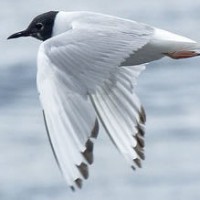
The Bonaparte’s Gull is the American equivalent of the Black-headed Gull. The shape of the dark hood and the white leading edge to the primaries are both strongly reminiscent of Black-headed Gull but the hood is actually sooty-black rather than brown, the legs are ‘bubble-gum’ pink and the underwing is much whiter, especially under the Read More …

Elephant Hawk Moth Caterpillar (Deilephila elpenor)

The larva of the Elephant Hawk Moth is about 75 millimetres (3.0 in) long and green and brown in colour. Like most hawk moth  caterpillars, they have a backward curving spine or “horn” on the final  abdominal segment. The  anterior of the caterpillar appears to have the shape of a trunk-like snout. It is this elephant Read More …

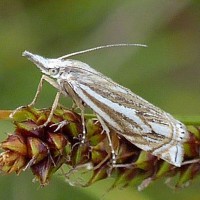
Catoptria margaritella (Pearl-band Grass Veneer)

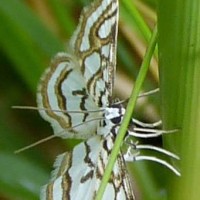
Even though the Pearl-band Grass Veneer flies by night only, it is easily disturbed during the day, especially in grasses. It is on the wing from mid-June to mid-August.  It prefers boggy areas, but is also seen on drier heaths. The Pearl-band Grass Veneer is a species of Northern Europe.  It is wide-spread and not Read More …

Bog Hoverfly (Sericomyia silentis)

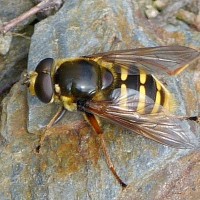
Among the best known wasp and bee mimics are the hoverflies, which do an impressive impersonation of their more dangerous distant cousins. Many hoverflies have evolved these black and yellow ‘don’t mess with me’ markings, but are just bluffing – they are completely harmless. The ruse is very effective however, and even humans who have Read More …

Green Carpet Moth (Colostygia pectinataria)

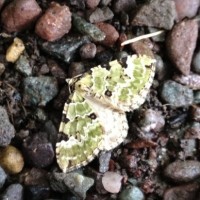
When freshly emerged like the photo above, the green colour of the forewing, combined with the wing markings, help to distinguish this moth from most others. This green colour fades to yellowish, whitish or even pinkish white with age. Widely distributed over England, Wales, Scotland, including the Hebrides and Orkney, and Ireland.  Also found on Read More …

Haematopotus pluvialis (Horse Fly)

Sometimes called Cleg Flies, adult horse flies feed on nectar and sometimes pollen. Females usually also feed on blood which aids in egg development. Males lack the necessary mouth parts for blood feeding. Most horse flies feed on mammal blood including humans, but some species are known to feed on birds, amphibians or reptiles. The Read More …

Libellula quadrimaculata (Four-spotted Chaser exuvia)

Exuvia are the cast-off skins or coverings of various organisms, such as the shells of crabs or the external coverings of the larvae and nymphs of insects. This one  possibly belongs to one of the Four-spotted Chasers we saw chasing each other down at Loch Charn during our field trip on Tuesday 29th May 2012. Read More …

Crambus lathoniellus (Hook-streaked Grass-Veneer)

Like several similar species, this micro moth is to be found in grassy areas. One of the earliest Crambids to be seen during the year, these adults fly from May through to August. It flies naturally at night, though it is easily disturbed in the daytime. The larvae feed on various types of grass stem. Read More …

Tipula fulvipennis (Crane-fly)

A Crane-fly is an insect in the family Tipulidae. Adults are very slender, long-legged flies that may vary in length from 2–60 millimetres. In the United Kingdom this species is usually referred to as daddy longlegs. The larva of the European Crane Fly is commonly known as a leather-jacket. These larvae can cause damage to lawns Read More …

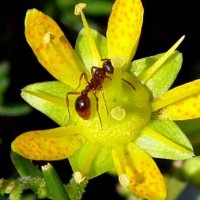
Myrmica ruginodis (Northern Red Ant)

Only a few people realise that there are two species of Common Red Ants. Myrmica ruginodis looks a lot like Myrmica rubra, but there is one striking difference, the spines on Myrmica ruginodis are longer. They are about as long as the distance between the tips of the spines. In Myrmica rubra the spines are Read More …